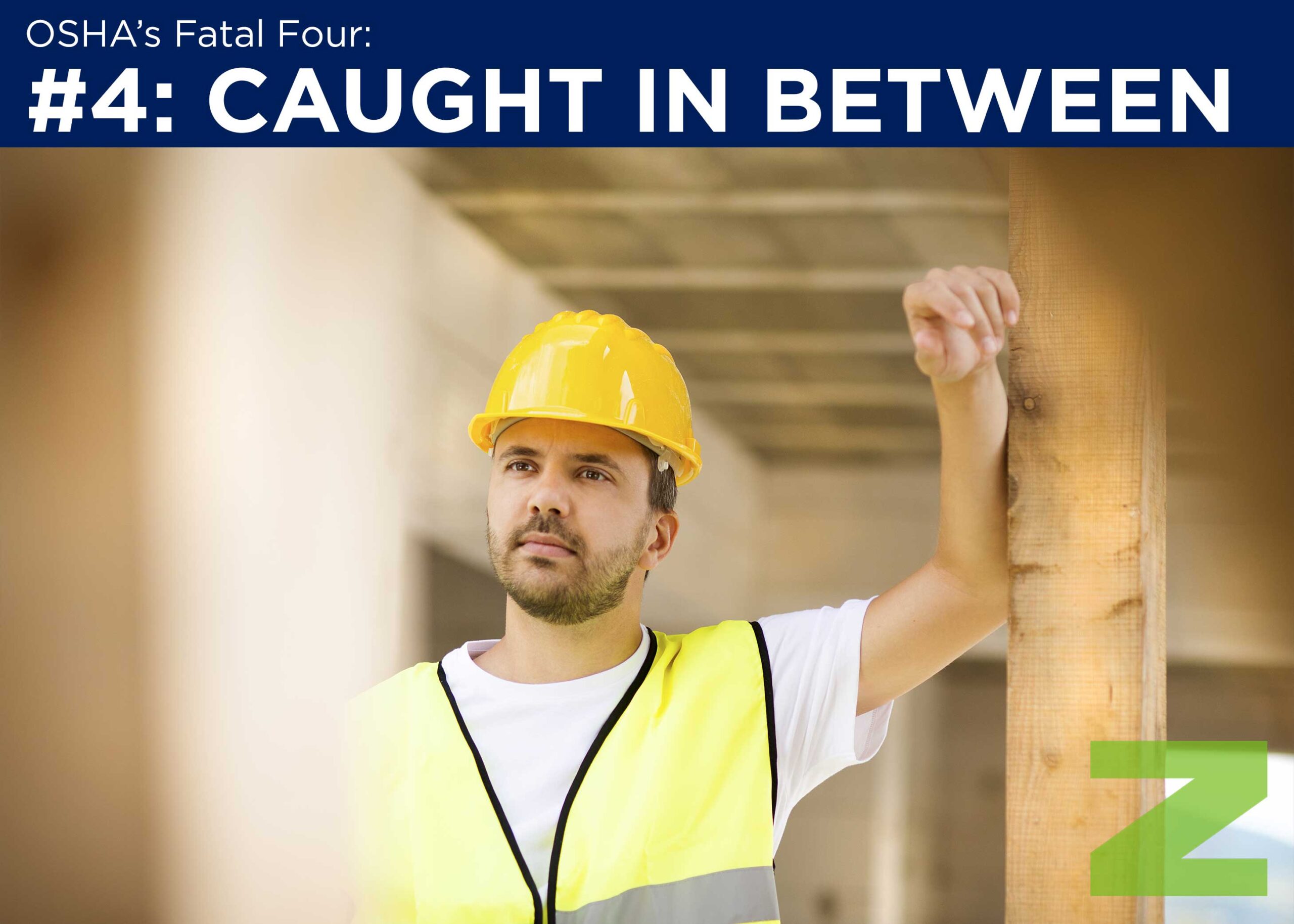
Zorn Insight, based in Vidalia, Georgia, provides workers’ compensation insurance and business insurance to construction contractors and small businesses across South and Central Georgia. Caught-in/between hazards are one of OSHA’s Fatal Four — the four hazard categories responsible for the majority of construction fatalities each year in Georgia and across the U.S. If you run a construction crew in Georgia, understanding what these hazards look like and how to prevent them is both a safety obligation and a direct factor in your workers’ comp costs.
Quick Answer: What Are Caught-In/Between Hazards at Georgia Construction Sites?
Caught-in/between hazards occur when a worker’s body — or a body part — is caught, crushed, pinched, or compressed between two objects, inside moving equipment, or in a collapsing excavation. In Georgia construction, the four main categories are: cave-ins during excavation and trenching work, contact with rotating or moving machinery, being caught between a piece of equipment and a fixed object, and being struck or pinned within the swing radius of cranes or other heavy equipment. Unlike falls, caught-in hazards often give workers no warning and no time to react.
In Zorn Insight’s experience working with South Georgia construction contractors, caught-in/between hazards are frequently overlooked in safety training because employers focus most of their prevention efforts on falls and struck-by incidents. But these are the hazard categories that regularly produce the most catastrophic workers’ compensation claims — injuries where there was no warning and no second chance.
Zorn Insight helps South Georgia contractors get the right coverage and understand what their policy covers when the worst happens.
Zorn Insight | 603 W. First Street, Vidalia, GA 30474 | 1-800-224-7951
Workers’ compensation insurance → | General liability insurance →
The Four Types of Caught-In/Between Hazards on Georgia Construction Sites
1. Excavation and Trenching Cave-Ins
Excavation work is one of the deadliest activities in construction. Workers in trenches and excavations are more than twice as likely to be killed as workers in any other type of construction activity. Excavations and trenches are inherently unstable, and Georgia soil conditions — which can change rapidly with heavy rain, frost, or equipment vibration — add to the risk.
Cave-ins can occur when:
- Soil is unstable, sandy, or saturated with water
- Heavy equipment or spoil piles are placed too close to the trench edge
- Vibration from nearby machinery, trucks, or traffic destabilizes the walls
- Weather changes — heavy rain or rapid freeze-thaw cycles — alter soil conditions quickly
- Utility lines run through the excavation zone and create additional hazards
OSHA requires protective systems — sloping, shoring, or trench boxes — for any excavation deeper than 5 feet. For excavations deeper than 20 feet, a registered professional engineer must design the protective system. These requirements apply to every Georgia construction contractor without exception.
2. Contact with Rotating or Moving Machinery
Unguarded rotating components — drill bits, saws, mixers, conveyor belts, augers — are a constant caught-in hazard on Georgia job sites. A momentary lapse in attention or a loose piece of clothing near a rotating shaft can result in severe and permanent injury in seconds. OSHA’s machine guarding standards (29 CFR 1910.212) require point-of-operation guarding on any machinery that could cause injury. On construction sites, this includes concrete mixers, power tools, and any powered equipment with exposed rotating parts.
Proper lockout/tagout (LOTO) procedures are the primary defense when workers need to maintain, adjust, or repair equipment. Every employee who services machinery must be trained and authorized under your company’s written LOTO program. This is not optional — it’s one of OSHA’s most frequently cited violations in Georgia construction.
3. Caught Between Equipment and a Fixed Object
This hazard occurs when a worker is positioned in a pinch point — between a piece of moving equipment and a stationary object like a wall, a vehicle, or a structure. Forklifts operating near loading docks, excavators swinging near site trailers, and vehicles backing toward buildings are all common pinch-point setups in Georgia construction environments.
Prevention requires clearly defined work zones, equipment spotters for blind spots, and barriers that prevent workers from entering the danger zone. Workers should never stand behind a vehicle that is moving or has the potential to move — even briefly.
4. Working Within Crane and Equipment Swing Radius
The swing radius of a crane or excavator creates a large and often underestimated danger zone. When a boom swings, it can travel 15 to 30 feet in seconds — and any worker in that arc who isn’t aware of the movement can be struck or pinned. Georgia construction sites with multiple equipment operators working simultaneously are especially high-risk for this type of incident.
OSHA requires exclusion zones around operating cranes. No worker should enter the swing radius without direct communication with the operator, and the operator should have full visibility of the work zone before moving. Spotters, barriers, and pre-shift safety briefings are the primary controls.
Caught-In/Between Hazards and Workers’ Comp Claims in Georgia
Caught-in incidents consistently produce some of the most severe and costly workers’ compensation claims in the construction industry. Crush injuries, amputations, and fatalities don’t just affect the injured worker — they affect your experience modifier (e-mod), which directly determines what you pay for workers’ compensation insurance in future years.
A serious caught-in claim can raise your e-mod above 1.0, meaning you’ll pay a premium surcharge on every policy renewal until your claims history improves. For small Georgia construction contractors, one bad claim in a year with no prior incident can significantly increase your insurance costs for three to five years.
This is one of the reasons Zorn Insight recommends that Georgia contractors review their safety programs annually — not just to meet OSHA requirements, but to protect their insurance costs over the long term. A well-documented safety program with LOTO procedures, excavation protocols, and equipment training records is also valuable when disputing workers’ comp claims or demonstrating due diligence if OSHA investigates an incident. See also: business insurance for Georgia contractors.
Q&A: Direct Answers for Georgia Construction Employers
What is a caught-in/between hazard and why is it in OSHA’s Fatal Four?
A caught-in/between hazard is any situation where a worker’s body or body part is compressed, pinched, or crushed between two objects — including cave-ins, moving machinery, equipment pinch points, and crane swing zones. OSHA designates these as part of the Fatal Four because they, along with falls, struck-by incidents, and electrocution, account for the majority of construction fatalities in the U.S. each year. In Georgia, caught-in incidents are especially common in excavation work and around heavy equipment.
Does Georgia workers’ comp cover caught-in/between injuries?
Yes. Georgia workers’ compensation insurance covers injuries that occur in the course of employment, including caught-in/between incidents. If an employee is injured in a trench cave-in, caught in rotating machinery, or pinned by equipment on a Georgia job site, workers’ comp covers their medical treatment, lost wages during recovery, and any permanent disability benefits if the injury causes lasting impairment. The key is having the right coverage in place before an incident happens — not after.
What should a Georgia contractor do immediately after a caught-in/between incident?
First, secure the scene and get medical help to the injured worker as quickly as possible. If the incident involves a fatality or requires hospitalization, OSHA must be notified within 8 hours (fatality) or 24 hours (hospitalization, amputation, or loss of an eye). Contact your workers’ comp carrier to report the claim and document everything — equipment condition, worker training records, witness statements. Zorn Insight recommends having your insurance agent’s contact information readily accessible on every job site so you can report quickly and correctly.
OSHA Requirements for Caught-In/Between Prevention in Georgia
Georgia construction employers must comply with OSHA’s construction standards (29 CFR 1926), which include specific requirements for:
- Excavations (Subpart P): Protective systems for trenches 5+ feet deep; competent person on site; no worker in an unprotected excavation
- Equipment guarding: All rotating and moving parts guarded; lockout/tagout program required for any maintenance or service work
- Cranes and derricks (Subpart CC): Exclusion zones, operator qualification requirements, and load capacity documentation
- Material handling: Forklift operator training, load stability requirements, and pedestrian/equipment separation
OSHA’s multi-employer citation policy means that general contractors can be cited for subcontractor violations on their job sites — even if the GC didn’t directly employ the injured worker. If you’re running a Georgia construction project with subcontractors, you have a compliance interest in their safety practices.
FAQ: OSHA Caught-In/Between Hazards for Georgia Construction Sites
How deep does a trench need to be before OSHA protective systems are required in Georgia?
OSHA requires a protective system — sloping, shoring, or a trench box — for any excavation that is 5 feet deep or greater. For excavations 20 feet or deeper, the protective system must be designed by a registered professional engineer. These requirements apply on all Georgia construction sites without exception, regardless of soil type or how quickly the work will be completed.
What is a “competent person” for excavation work under OSHA standards?
OSHA defines a competent person as someone who is capable of identifying existing and predictable hazards in the surroundings or working conditions that are unsanitary, hazardous, or dangerous, and who has the authority to take prompt corrective measures to eliminate those hazards. For excavation work, a competent person must inspect the excavation daily before work begins and after any event — such as heavy rain — that could affect soil stability. Being the crew’s most experienced worker isn’t enough; the competent person must have specific knowledge of excavation hazards and soil classification.
Can OSHA cite a general contractor for a subcontractor’s caught-in violation in Georgia?
Yes. OSHA’s multi-employer citation policy allows OSHA to cite any employer who has the ability to control a hazard — including general contractors who supervise or manage subcontractors on a construction site. If a subcontractor’s employee is caught in unguarded machinery or injured in a trench that lacked a required protective system, the GC can be cited alongside the subcontractor if they had the authority to correct the hazard and didn’t.
What is lockout/tagout and when is it required on Georgia job sites?
Lockout/tagout (LOTO) is a safety procedure that ensures hazardous energy sources — electrical, hydraulic, pneumatic, mechanical — are isolated and de-energized before a worker services or maintains equipment. OSHA requires a written LOTO program and specific trained, authorized employees for all service and maintenance work on any equipment with the potential for unexpected startup. On Georgia construction sites, this includes concrete mixers, aerial lifts, compressors, and any powered equipment that could move or activate unexpectedly during maintenance.
How do caught-in/between incidents affect workers’ comp premiums for Georgia contractors?
Serious caught-in claims — particularly those involving amputations, crush injuries, or fatalities — produce large claims that can significantly raise your experience modifier (e-mod) for three to five years following the incident. An e-mod above 1.0 means you pay a premium surcharge on every workers’ comp policy renewal. For small Georgia contractors, a single catastrophic claim without prior loss history can increase annual premiums by 20–40% or more. Maintaining strong safety programs, documenting training, and having proper coverage in place before an incident are the best protections for both your workers and your insurance costs.
About Zorn Insight — Workers’ Compensation and Business Insurance for Georgia Contractors
Zorn Insight is an independent insurance, payroll, and HR agency based in Vidalia, Georgia, serving construction contractors and small businesses across South and Central Georgia. We provide workers’ compensation insurance, general liability insurance, and full business insurance coverage to Georgia contractors who need the right protection in place before something goes wrong on the job site.
We also offer payroll and HR services for Georgia employers who want to manage their workers’ comp coordination, payroll, and compliance from one place. If you have questions about your coverage or need a certificate of insurance for an upcoming project, reach out directly:
Zorn Insight
603 W. First Street, Vidalia, GA 30474
1-800-224-7951